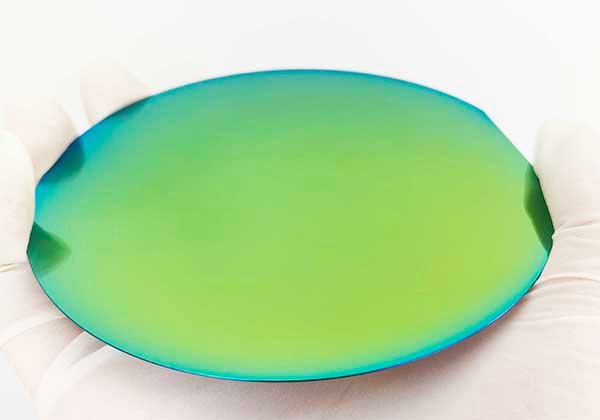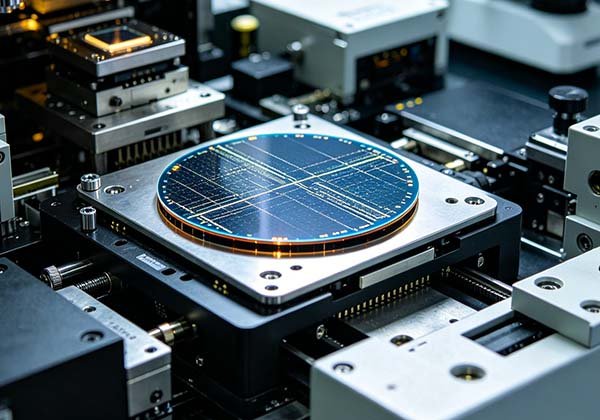


In the semiconductor industry chain, wafers are the core substrates for chip manufacturing and are often called the foundation of the semiconductor industry. As the material carrier of semiconductor devices, wafer quality directly determines chip performance, power consumption and reliability.
A semiconductor wafer is a thin slice of highly purified semiconductor material with a specific crystal structure. The key property of semiconductor materials is controllable conductivity. They do not conduct current as freely as metals and do not block current completely like insulators; instead, their conductivity can be precisely controlled through doping, illumination and temperature changes.
As the carrier of semiconductor devices, wafers must have high purity, nearly perfect crystal structure and uniform physical properties to meet the requirements of lithography, etching, doping and other complex manufacturing steps.
Semiconductor wafers can be divided into elemental semiconductors and compound semiconductors. Silicon wafers dominate the elemental category and account for the majority of the global wafer market. Silicon is abundant, relatively low-cost and has excellent oxidation properties. It can form a stable SiO₂ insulating layer, which is the foundation of MOSFET manufacturing. Silicon also has stable mechanical properties and is easy to cut, grind and polish for mass production.
Compound semiconductors occupy a smaller market share but are indispensable in specific fields. GaAs provides high-frequency, high-speed and radiation-resistant properties for RF devices, optical communication and aerospace electronics. GaN and SiC are wide-bandgap semiconductors that offer high-temperature, high-voltage and low-loss performance, making them important for new energy vehicles, 5G base stations and photovoltaic inverters.
Wafer preparation is a high-precision and complex process that includes crystal growth, slicing, grinding, polishing and cleaning. In the Czochralski method, high-purity material is melted in a quartz crucible, a seed crystal is inserted, and controlled temperature, rotation and pulling speed allow the melt to solidify into a cylindrical single-crystal ingot.
The ingot is sliced with precision diamond blades into wafers of uniform thickness. Grinding removes cutting marks and surface defects. CMP polishes the wafer to a mirror finish with nanometer-level roughness. Strict cleaning then removes surface particles and contaminants to meet chip-fabrication cleanliness requirements.
Mainstream wafer sizes include 4-inch, 6-inch, 8-inch and 12-inch wafers. Larger wafers can produce more chips per wafer and reduce unit manufacturing cost. They also represent higher process capability. Today, 12-inch wafers are the mainstream for high-end logic and memory chips, while 18-inch wafers remain a future research direction.
Semiconductor wafer materials form the foundation of the semiconductor industry. Breakthroughs from silicon to compound wafers and from small to large wafer sizes continue to drive progress in chip manufacturing and industrial competitiveness.